Understanding Third-Party Logistics and How It Can Help Your Business Grow
We’ve found that not everyone knows what a 3PL is.
But when we explain that we receive merchandise, store inventory, and prepare shipments for other businesses, people tend to understand what we do pretty quickly.
3PL stands for third-party logistics. Third-party logistics companies handle a variety of responsibilities for other businesses, including warehousing, fulfillment, distribution, and transportation.
At C&O, our work is primarily on the warehouse side of that equation.
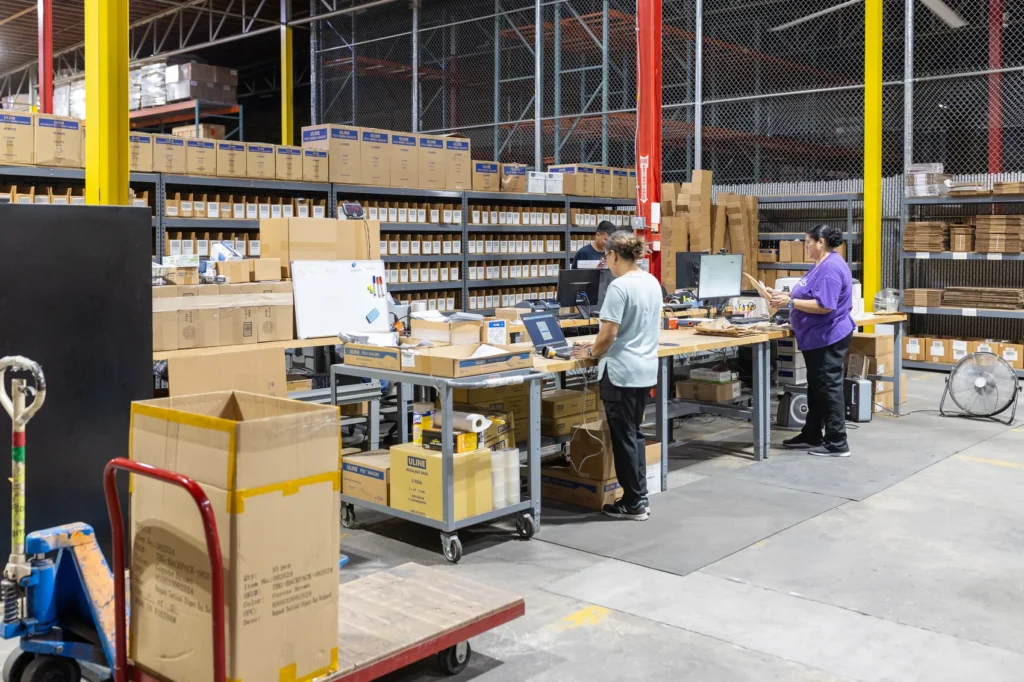
We provide the space, equipment, and personnel to receive, store, and ship products for businesses that don’t necessarily want to operate a warehouse themselves.
That gives growing businesses access to an established warehouse operation without having to invest in the space, equipment, and personnel themselves.
And because those resources are part of an established operation, customers can rely on us to handle the daily warehousing and fulfillment work they’ve entrusted to us.
What Services Does a 3PL Provide?
There’s no single list of services that every 3PL provider offers.
Some third-party logistics companies focus primarily on transportation. Others specialize in managing the physical inventory and shipping operations of the businesses they serve.
At C&O, we’re primarily a warehousing, distribution, and fulfillment company.
Our services include:
- Receiving and storage: We receive merchandise, unload incoming shipments, and organize products in our warehouse.
- Inventory tracking: We maintain records of the products in our care and track inventory as orders are filled.
- Order fulfillment: We locate products, pick and pack orders, and prepare shipments.
- Distribution: We prepare merchandise for shipment to the destinations our customers specify.
- Kitting and light assembly: We combine products into kits or perform certain basic assembly work.
- Local delivery: We transport merchandise to nearby destinations using our box trucks.
The work can look different from one customer to the next.
For a manufacturer, we might store finished merchandise and prepare shipments as orders arrive. For an ecommerce business, we might handle a steady flow of individual customer orders.
In either case, the customer remains responsible for purchasing and replenishing inventory. We handle the physical warehousing and fulfillment activities we’ve agreed to provide.
How Does Working With a 3PL Actually Work?
A customer arranges for merchandise to arrive at our warehouse. We receive it, organize it, and track the inventory.
When orders come in, our team picks and prepares the products for shipment according to the customer’s instructions.
One thing that surprises some businesses is that their merchandise doesn’t necessarily need to return to their facility before being shipped.
Some businesses assume we’ll store their inventory until they need it, then send it back to them so they can prepare and ship the orders themselves.
But in many cases, we can handle fulfillment directly from our warehouse, saving them an extra step in the process.
Why Use a 3PL Instead of Operating Your Own Warehouse?
One of the biggest advantages of 3PL warehousing is that you’re gaining more than storage space.
You’re also gaining access to the people and equipment needed to manage your inventory and shipments.
And in our experience, labor can be an even bigger consideration than the cost of the building itself.
Imagine a manufacturer that ships three orders on Monday, ten on Tuesday, and none for the remainder of the week.
The workload changes, but the cost of maintaining its own warehouse and staffing the operation doesn’t necessarily change with it.
What do those employees do when there aren’t any orders to prepare?
At C&O, we work with multiple customers throughout the day. That allows us to allocate our warehouse personnel to different operations as workloads change.
A customer with only a few orders doesn’t necessarily need dedicated employees waiting around for the next shipment.
And when volume increases, we can adjust how we allocate our available resources.
Understanding the Cost of Running Your Own Warehouse
Businesses considering their first 3PL provider sometimes have trouble comparing costs because they haven’t separated their existing warehouse expenses into individual categories.
They know what they’re paying for their building and employees, but may not know exactly what it costs to receive, store, handle, and ship their products.
There’s rent, staffing, equipment, utilities, maintenance, and the time required to manage everything.
Working with a 3PL doesn’t automatically guarantee lower costs. Instead, you’re paying a 3PL provider to handle the services you need, using the personnel, equipment, and facilities already in place.
For businesses with fluctuating workloads, that can be a much more practical arrangement than maintaining an entire warehouse operation themselves.
When Does Outsourcing Warehousing Make Sense?
Two of the most common reasons businesses contact us are that they’ve run out of space or their order volume no longer fits comfortably into their existing workflow.
If you’re considering a 3PL, we’d encourage you to ask yourself three questions:
- Do I have enough space for my inventory?
- Do I have the labor to meet my customers’ needs?
- Can my operation accommodate changes in demand?
At C&O, we understand that a customer’s needs today may look very different six months from now.
We can adjust how we use our space and personnel as those needs change, provided we have enough notice to plan for significant increases in inventory or shipments.
But we also recognize that not every business needs a 3PL. If you’ve got the space, the people, and a steady enough workload to handle everything efficiently, keeping your warehouse operation in-house may be the right move.
What Types of Businesses Benefit From a 3PL?
A common misconception about third-party logistics is that it’s only for large companies with enormous quantities of inventory.
But businesses don’t necessarily need hundreds of pallets or daily shipments to benefit from a 3PL.
Manufacturers and Distributors
Some manufacturers need somewhere to keep finished products until customers are ready for them. Others need help preparing and shipping orders as they come in.
Distributors may have different requirements, particularly when they’re receiving merchandise from multiple suppliers and sending it to customers across several locations.
At C&O, we can help with the warehousing, inventory tracking, and distribution work involved in both operations.
Ecommerce Businesses
For ecommerce businesses, selling the product is only part of the process. Someone still has to store it, find it when an order comes in, pack it, and ship it.
That’s the work a 3PL fulfillment provider can handle.
Rather than managing those tasks internally, businesses can rely on an established warehouse operation to keep orders moving.
Businesses With Specialized Storage and Distribution Needs
Not every organization that needs a warehouse is a manufacturer or retailer.
We’ve worked with professional organizations that needed printed materials stored and distributed but operated from offices without loading docks or warehouse equipment.
At C&O, we don’t believe a business needs to have a huge inventory to benefit from a 3PL warehouse.
Some customers simply need us to store their materials and handle distribution when something needs to go out.
What Should You Look for in a 3PL Provider?
When comparing third-party logistics companies, start by making sure they can handle your products and the services you need.
Not every provider has the same equipment, experience, or capabilities.
At C&O, for example, we focus primarily on warehousing, distribution, fulfillment, and local delivery. We don’t operate as a full-service freight brokerage, and there are certain products and industries we don’t handle.
We believe it’s better to be upfront about those limitations than to take on work we’re not properly equipped to perform.
We’d encourage prospective customers to ask:
- Do you have experience handling products like mine? Make sure the provider understands your merchandise and any special requirements.
- Can you accommodate changes in my inventory and order volume? Ask about capacity, flexibility, and advance notice.
- How will my inventory be tracked? Understand what information you’ll have access to.
- What does your pricing include? Ask about storage, receiving, handling, fulfillment, and additional charges.
- Who will I communicate with? Find out how questions and unexpected situations are handled.
We’d add one more consideration: honesty.
Good communication is part of what makes a warehousing relationship successful.
At C&O, we need to understand what our customers are storing, how much inventory they’re sending us, and what their normal order volume looks like.
A promotion that could triple shipments, for example, is something we need to know about ahead of time so we can prepare.
Likewise, we make sure our customers understand our receiving procedures, scheduling requirements, and shipping cutoff times.
Good communication on both sides helps us plan appropriately and meet expectations.
More Than Warehouse Space: A Partner in Your Business
When you work with a 3PL provider, you’re trusting another company with an important part of your business.
Your products are in their warehouse. Their employees are handling your inventory and preparing shipments for your customers.
At C&O, we understand what that responsibility means.
We want to be an extension of your business, doing our part to keep your operation moving and communicating with you as your needs change.
That’s also why we believe in taking the time to understand prospective customers before recommending a solution.
You don’t need to know all the ins and outs of third-party logistics to have that conversation.
If you’re running out of room, struggling to keep up with orders, or wondering whether there’s a better way to manage your inventory and distribution, tell us what’s happening.
We’ll listen, ask questions, and help you decide whether our services are a good fit.
Let’s move your business forward.